The Thai job market explained: What employers really look for today


Over the past few years, Thailand’s job market has undergone a noticeable transformation. Navigating a tightening economy, rising operational costs, rapid AI integration, and shifting workforce expectations have all fundamentally reshaped how organisations hire. Today, recruitment is no longer just about filling vacancies—it has become a strategic decision closely tied to business sustainability.
As a job platform connecting employers and job seekers, Thai Job observes these shifts from both sides of the market. The signals are clear: employers are becoming more selective, more practical, and increasingly focused on long-term value.
The job market as a reflection of the economy
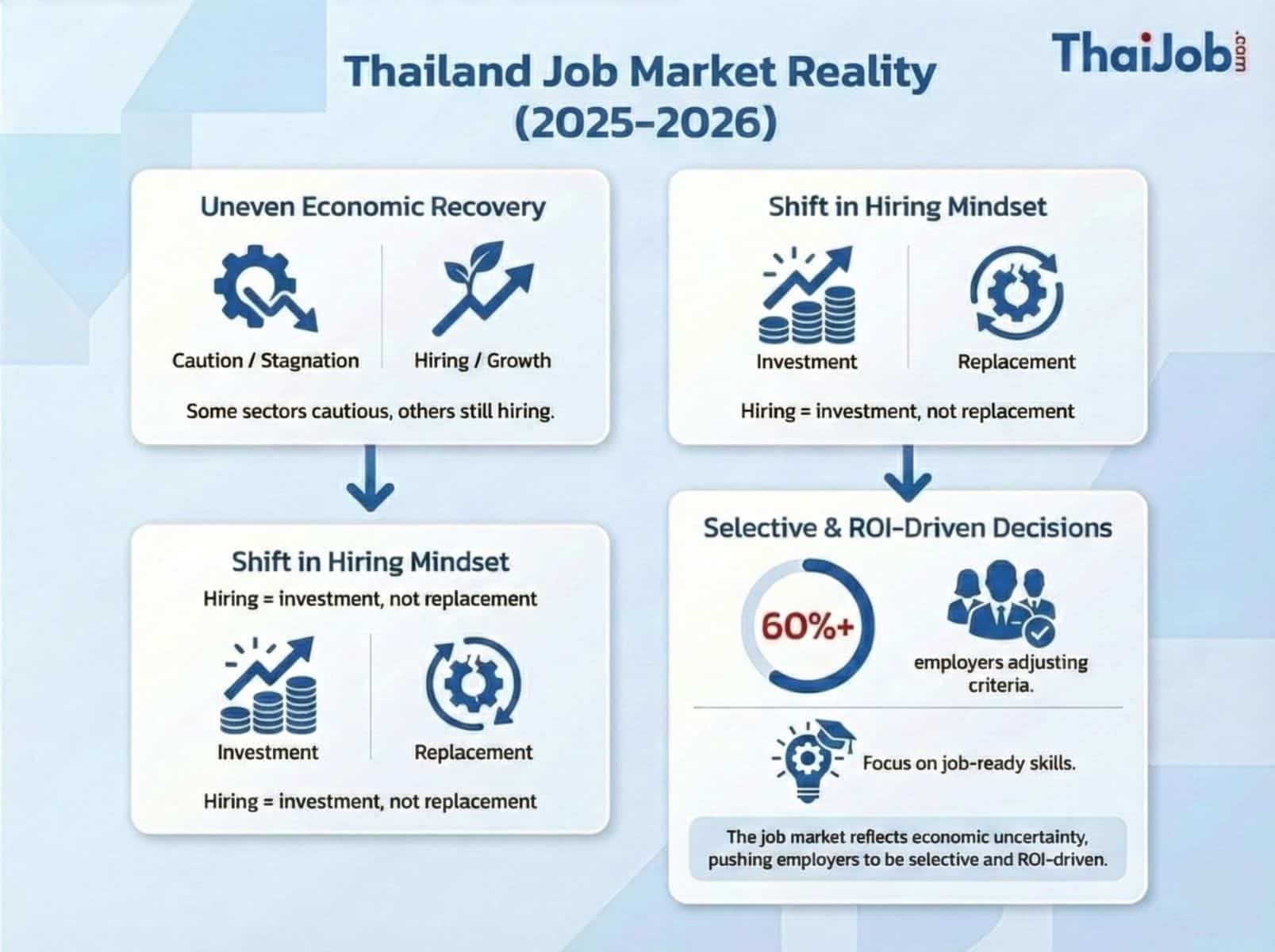
Looking at labour market trends entering 2026, Thailand’s economy is stabilising but remains highly competitive, with growth distributed unevenly across industries. While some sectors remain cautious about expansion, others, particularly digital services and marketing, continue to hire steadily.
This uneven recovery has led employers to prioritise “value for money” when hiring. Recent labour market insights suggest that over 60% of Thai organisations have adjusted their recruitment criteria, placing greater emphasis on practical skills and job readiness rather than formal academic qualifications alone.
In other words, hiring a new employee today is a strict ROI calculation. Employers are looking beyond degrees to assess ‘Speed to Value’—how quickly a candidate can contribute under tighter budget constraints
What Thai employers value more than ever
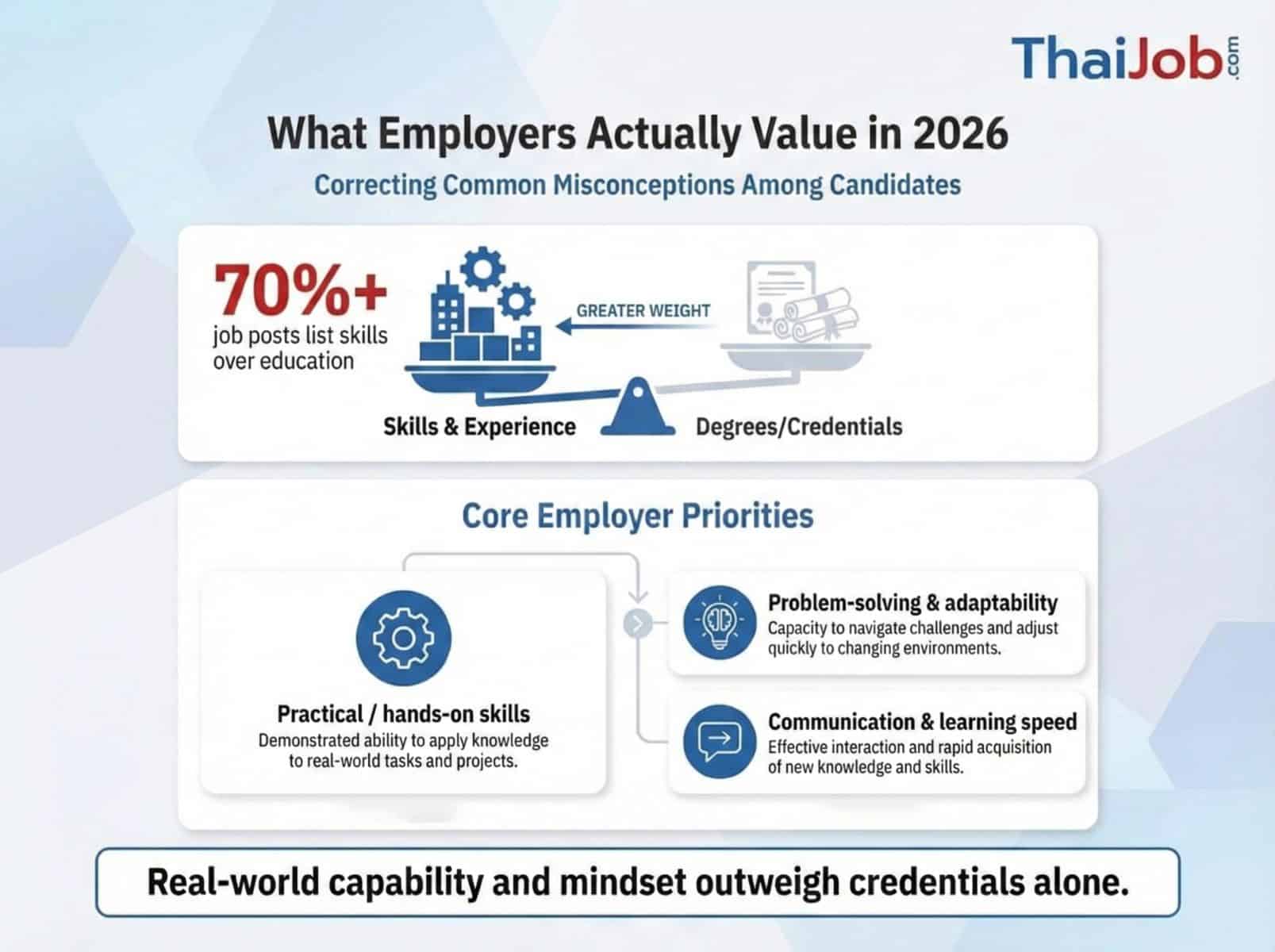
Job posting trends on Thai Job indicate a clear shift in employer expectations. Many organisations now focus less on educational background and more on skills that can be applied immediately in the workplace.


In fact, more than 70% of job postings on the platform explicitly list hands-on skills or relevant work experience as key selection criteria. Candidates who can demonstrate practical knowledge, familiarity with tools, and an understanding of workplace systems tend to stand out more than those with polished résumés but limited real-world exposure.
Problem-solving and analytical thinking have also become essential. Employers increasingly seek professionals who can identify issues, propose solutions, and make informed decisions, capabilities that are critical as businesses navigate rapid change.
Mindset matters: Attitude as a hiring factor
Beyond skills, mindset plays a growing role in hiring decisions. Thai employers value candidates who are open to learning, flexible, and willing to grow alongside the organisation. In a labour market where long-term job security is no longer guaranteed, individuals with a growth mindset are often seen as long-term assets.
Behavioural insights from applications on Thai Job show that candidates who clearly communicate their career goals and demonstrate an understanding of business direction tend to receive more positive responses than those seeking stability alone.
Hiring reality vs. candidate expectations in 2026
Employers and candidates operate in the same job market, but often with very different priorities.
Employers in 2026 are focused on efficiency and leanness. With stabilised but cautious budgets, hiring is treated as a critical business manoeuvre rather than a routine expansion.
Many candidates, however, still prioritise salary, flexibility, and work-life balance. While these expectations are valid, they do not always align with what employers urgently need.
This gap helps explain a common frustration in Thailand’s job market: high application volume but few interview callbacks. In many cases, the issue is not capability—but misalignment.
Understanding this reality allows professionals to position themselves more effectively and reduce hiring mismatches.
What employers rarely say out loud
Some hiring decisions are shaped by factors rarely stated in job descriptions.
A well-written résumé may not move forward if it fails to show a clear, real-world impact. Employers look for evidence of application, not just credentials.
Communication is another silent filter. Clear, structured communication often matters more than technical excellence, as poor communication slows teams and increases operational risk.
Learning speed also matters. In fast-moving organisations, slow adaptation becomes a cost. Employers, therefore, value candidates who learn independently and adjust quickly.
These insights are not criticisms, but they reflect how businesses operate under pressure.
Skills in demand amid economic uncertainty
Data from job listings on Thai Job highlight several skill sets that cut across industries. AI fluency, digital adaptability, and data-driven decision-making are repeatedly mentioned. Employers now expect staff to leverage AI tools to increase personal productivity and speed.
Employers also value skills that improve efficiency, such as performance-driven marketing, cross-functional collaboration, and data-informed decision-making. These capabilities help organisations remain competitive in a volatile economic environment.
Language proficiency and cross-market understanding are gaining importance as well, particularly for companies looking to expand regionally or engage with international partners.
How employers evaluate ‘value’ in the first 90 days
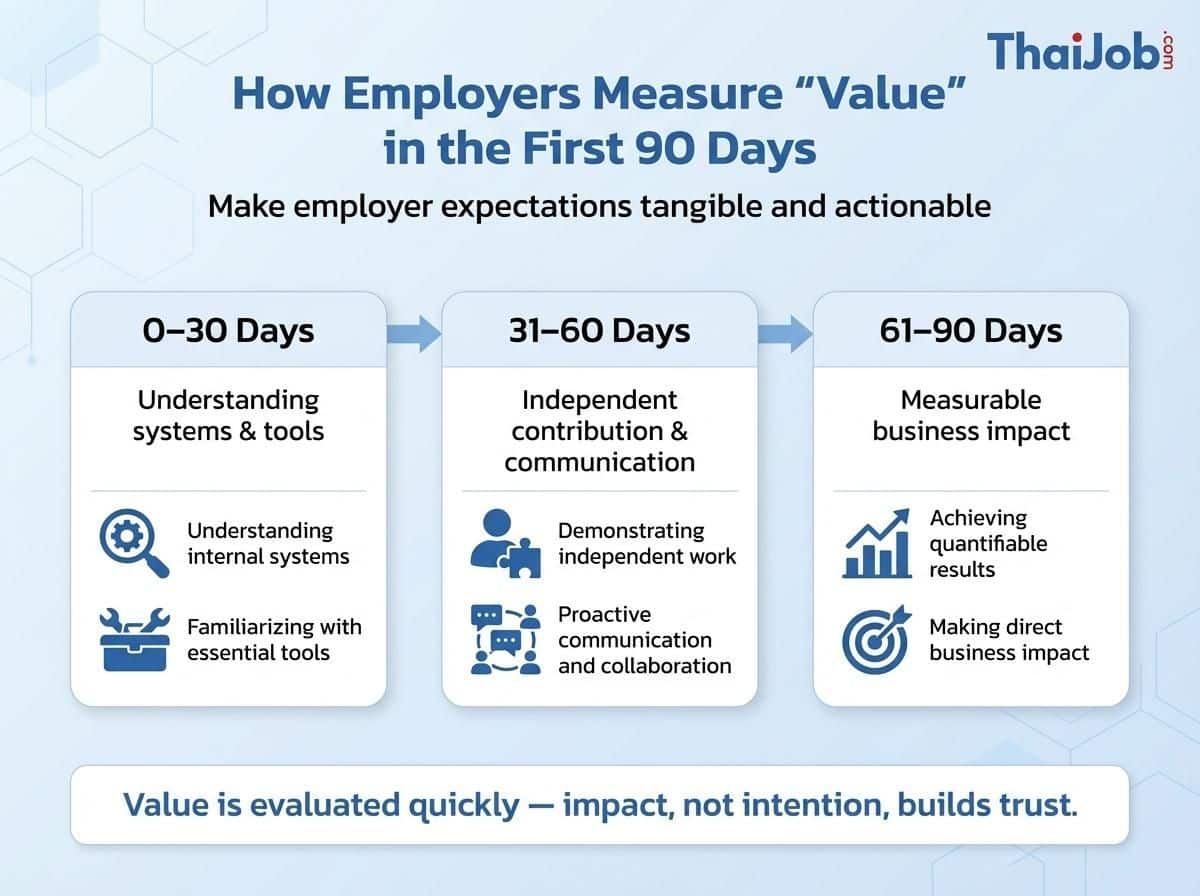
Employers typically assess new hires in stages.
First 30 days: How quickly does the employee understand systems, tools, and expectations?
By 60 days: Can they contribute with less supervision and communicate effectively within the team?
By 90 days: Do they create measurable value through problem-solving, collaboration, or process improvement?
Employees who demonstrate initiative, alignment with business goals, and consistent progress build trust early and increase their long-term growth potential.
A global shift with local context
Similar hiring trends can be observed globally, where employers increasingly prioritise skills, adaptability, and measurable business impact over formal credentials alone. Thailand’s job market follows this broader direction while adapting to its own economic structure and industry mix.
Understanding Thailand’s labour market, therefore, requires both a global lens and local insight—something increasingly important for international professionals and organisations operating in the country.
Signals the job market is sending to professionals
Today’s Thai job market does not indicate a lack of opportunities, but it signals a change in the nature of work. Professionals who continuously upskill and adapt gain access to more options, while career security increasingly depends on individual capabilities rather than organisational promises.
Platforms like Thai Job therefore serve not only as job listings, but also as reflections of market demand, helping professionals understand what employers truly expect at different stages of economic change.
What this means for employers
For employers, hiring in 2026 requires greater clarity.
Unclear job descriptions attract misaligned candidates and increase recruitment costs. Clear expectations reduce friction and improve hiring outcomes.
Employer branding is now as important as compensation. Candidates evaluate leadership style, growth opportunities, and workplace culture before applying.
Successful hiring today is less about speed and more about alignment. This is where Thai Job helps bridge expectations between employers and talent.
Who does this matter for?
These insights are relevant not only to Thai professionals but also to international talent, expatriates, regional employers, and global businesses seeking to understand how hiring decisions are made in Thailand today.
From an employer’s perspective, recruitment in 2025 is less about expanding headcount and more about securing talent that can deliver real results from day one.
Understanding the market gives you an advantage

Ultimately, understanding Thailand’s job market means understanding the economy from an employer’s perspective. Professionals who grasp these dynamics can plan their careers more strategically and adapt more effectively.
In an era where hiring decisions go far beyond academic credentials, access to accurate, up-to-date labour market insights becomes a true competitive advantage. This is where Thai Job aims to play a role, helping bridge understanding between employers and talent in Thailand’s evolving job market.
Key takeaways for professionals in 2026:
- Demonstrable skills matter more than credentials alone
- Employers value adaptability and real business impact
- Continuous upskilling is the new form of career security
In 2026, it’s not just the most polished résumé that wins; it’s the ability to demonstrate immediate impact, leverage technology for efficiency, and solve problems autonomously.
Sponsored
Latest Thailand News

























Follow The Thaiger on Google News: