Arriving in Thailand with too much cash? Here’s what to do
The rules, thresholds, and penalties every traveller should know before landing in Thailand with large amounts of cash

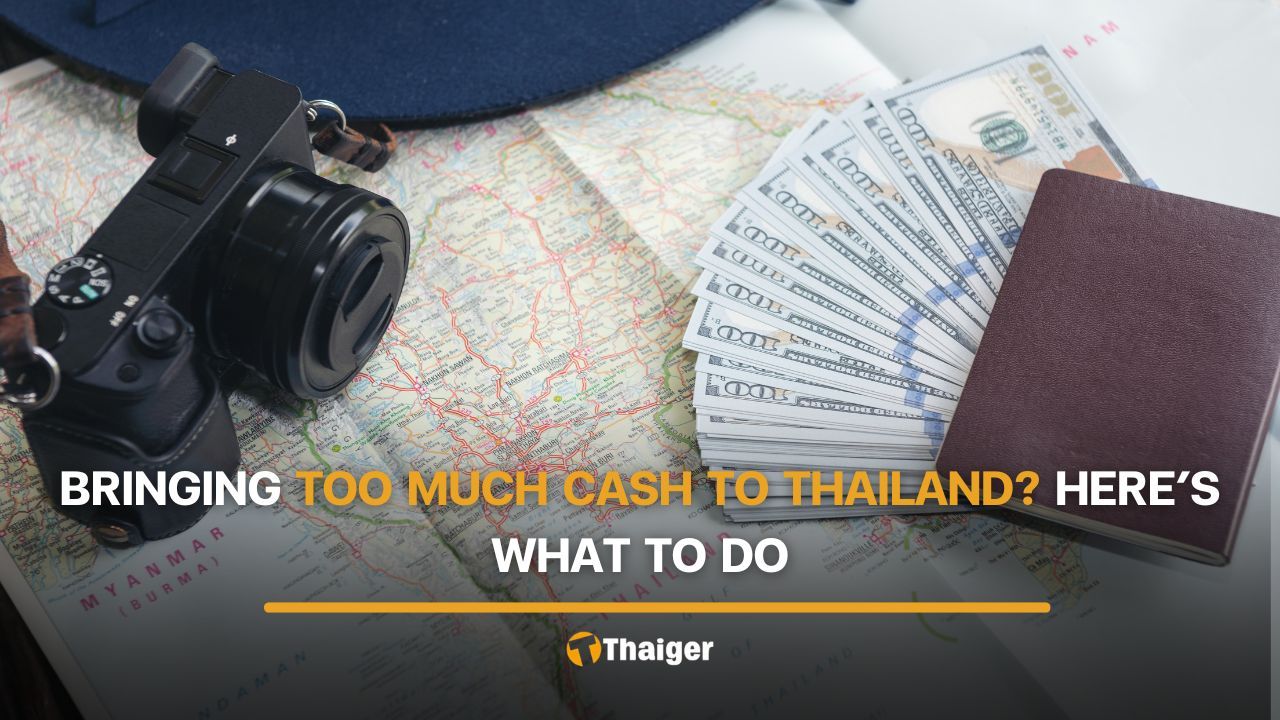
You step off the plane at Suvarnabhumi Airport with an oddly specific stack of US$25,000 tucked into your carry-on, maybe it’s relocation savings, a property deposit, or business capital. At the gate, the question hits you as you approach baggage claim: Do you need to declare this?
The short answer: yes. But the exact threshold that triggers a mandatory declaration depends on which official source you consult, and getting it wrong can result in immediate seizure, criminal penalties, and a very bad start to your time in Thailand.
On this page
| Section (Click to jump) | Summary |
|---|---|
| The threshold: is it US$15,000 or US$20,000? | Thailand allows large cash amounts but requires declaration above the safe threshold of US$15,000 (or around 468,750 Thai baht). Combined currency totals may also trigger declaration rules. |
| How to declare at the airport | Travellers must use the Red Channel, complete the customs currency declaration form, present supporting documents, and keep the stamped form for departure and banking purposes. |
| What happens if you don’t declare | Failing to declare cash can lead to confiscation, fines, imprisonment, and referral to anti-money laundering authorities. Seized funds may become state property after 30 days. |
| Other important rules | Tourists must carry a minimum amount of cash for entry, Thai baht export limits apply, and safer alternatives include transfers, remittance services, and e-wallets. |
| If something goes wrong | Key helplines include Thai Customs, Tourist Police, Bank of Thailand, and legal aid services for assistance if issues arise during entry or declaration. |
The threshold: is it US$15,000 or US$20,000?

Thailand does not ban you from entering with large amounts of foreign currency, but you must declare it once you cross a specific limit. However, the problem is that different official sources cite different figures, creating real confusion at the border.
The stricter threshold (US$15,000): The Bank of Thailand explicitly states that carrying foreign currency banknotes over USD 15,000 or equivalent requires a customs declaration. This figure also appears on the official Thai Customs declaration form itself, in bilingual airport guidance published by the Civil Aviation Authority of Thailand, and in Airports of Thailand materials.
The older threshold (US$20,000): Several Thai embassy websites and government PR pages still reference US$20,000 as the trigger for declaring foreign currency, contradicting the lower figure used at the actual border.


However, to play it on the safe side and to avoid disputes, seizure risk, or delays, declare when you are at or above US$15,000 (or 468,750 Thai baht). This eliminates any argument over which threshold applies and keeps you firmly on the safe side of compliance.
Additionally, even if each currency you carry is below the threshold, Thailand applies a combined-value rule: if your total foreign currency, Thai baht, and certain negotiable instruments (bearer cheques, endorsed bills) exceed roughly 450,000 to 500,000 baht, you must declare.
How to declare at the airport
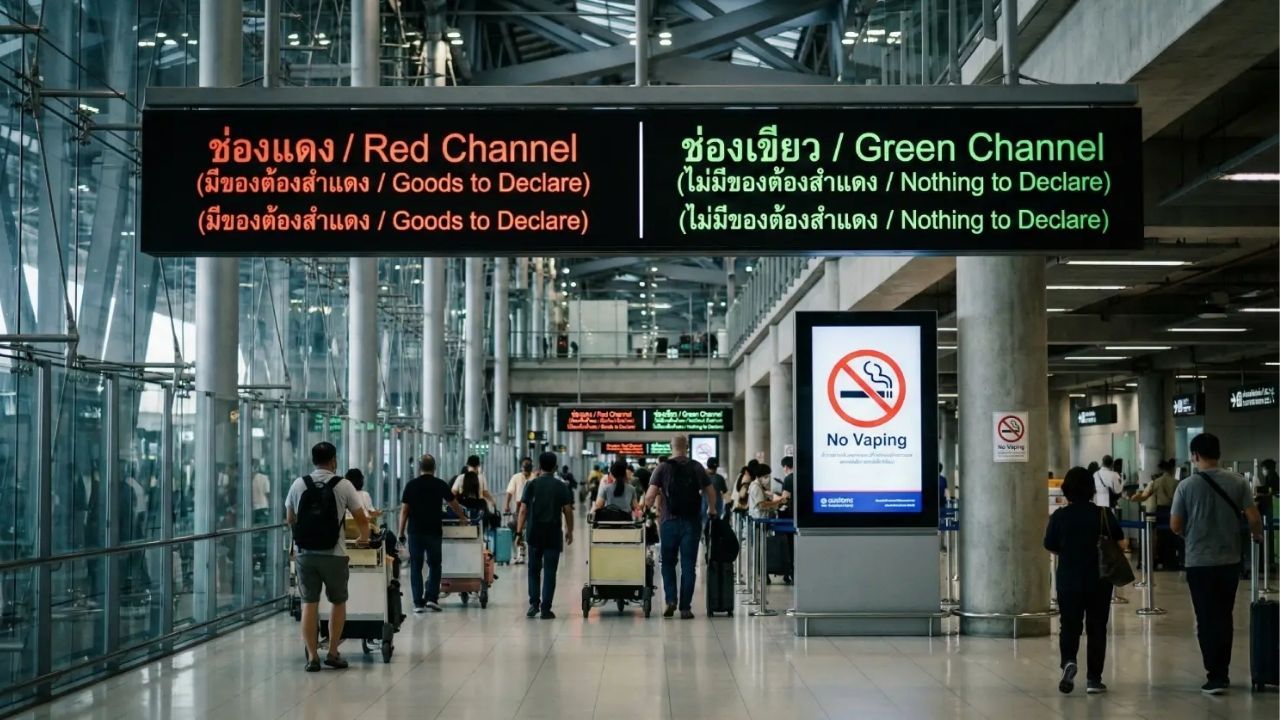
After collecting your baggage, you will face two customs channels:
- Green Channel (Nothing to Declare): For travellers under all thresholds
- Red Channel (Goods to Declare): Where you must go if you exceed the limits
Step 1: Do not use the Green Channel. Go directly to the Red Channel after baggage claim.
Step 2: Approach a customs officer and request the “Customs Declaration Form for Thai or Foreign Currency or Negotiable Monetary Instruments.”
Step 3: Complete the form with your identity details, travel information, exact amounts by currency, source of funds, and intended use.
Step 4: Present your passport, boarding pass, and any supporting documentation showing the source of the money (bank withdrawal receipt, sale contract, payslip).
Step 5: Officers will verify and count your cash. The process is free and typically takes around 15 minutes.
Step 6: Keep the stamped declaration form. You will need it when departing Thailand and when depositing large sums at Thai banks.
What happens if you don’t declare

Attempting to pass through the Green Channel with undeclared cash is not treated as an administrative mistake; it is prosecuted as a criminal customs offence.
| Violation | Penalty |
|---|---|
| Failure to declare foreign currency (Exchange Control Act) | Fine up to 20,000 baht + imprisonment up to 3 years |
| Smuggling / avoiding customs (Customs Act) | Imprisonment up to 10 years or a fine of 4 times the value of the goods |
| Providing false information to customs | Imprisonment up to 6 months or a fine of up to 500,000 baht |
| Immediate consequence | Total asset confiscation + referral to Anti-Money Laundering Office |
If your cash is seized, it becomes state property after just 30 days if you do not file a proper claim in Thailand.
Other important rules

Minimum cash requirement: Tourists must carry at least 20,000 baht per person (or 40,000 baht per family) in physical currency to satisfy immigration officers. Digital bank statements are not accepted.
Thai baht export limits: You can take out a maximum of 50,000 baht when leaving Thailand (or up to 2 million baht if travelling to bordering countries, Vietnam, or Yunnan, but amounts over 450,000 to 500,000 baht still require declaration).
Alternatives to carrying cash include International bank transfers, licensed remittance services, and e-wallets like TAGTHAi Easy Pay, which offer safer, more traceable options for moving large sums.
If something goes wrong
| Contact | Number/Details |
|---|---|
| Thai Customs Call Centre | 1164 |
| Suvarnabhumi Airport Customs Office | +66 2 134 0400 |
| Tourist Police (English-language help) | 1155 |
| Bank of Thailand Hotline | 1213 |
| Legal Aid Hotline | 1167 |
Large amounts of cash attract scrutiny everywhere, but Thailand’s customs and anti-money laundering enforcement are unforgiving. Declaring excess currency is straightforward if your funds are legitimate and documented. Trying to avoid it, however, can cost you everything you brought and your freedom.
Related articles:
• Don’t carry cash in Thailand
• The essential guide to domestic flights in Thailand
• Expat’s guide to QR payments in Thailand
Sources:
• Bank of Thailand – Foreign Exchange Regulations
• Civil Aviation Authority of Thailand – eAIP Passenger Entry Guidance
Latest Thailand News

























Follow The Thaiger on Google News: