Thailand hits 60-year investment record as Amazon, Google, BYD and others bet big
While macro statistics paint a grim picture of debt and stagnation, global giants like Google and Amazon are betting billions on a version of Thailand that the headlines are missing.

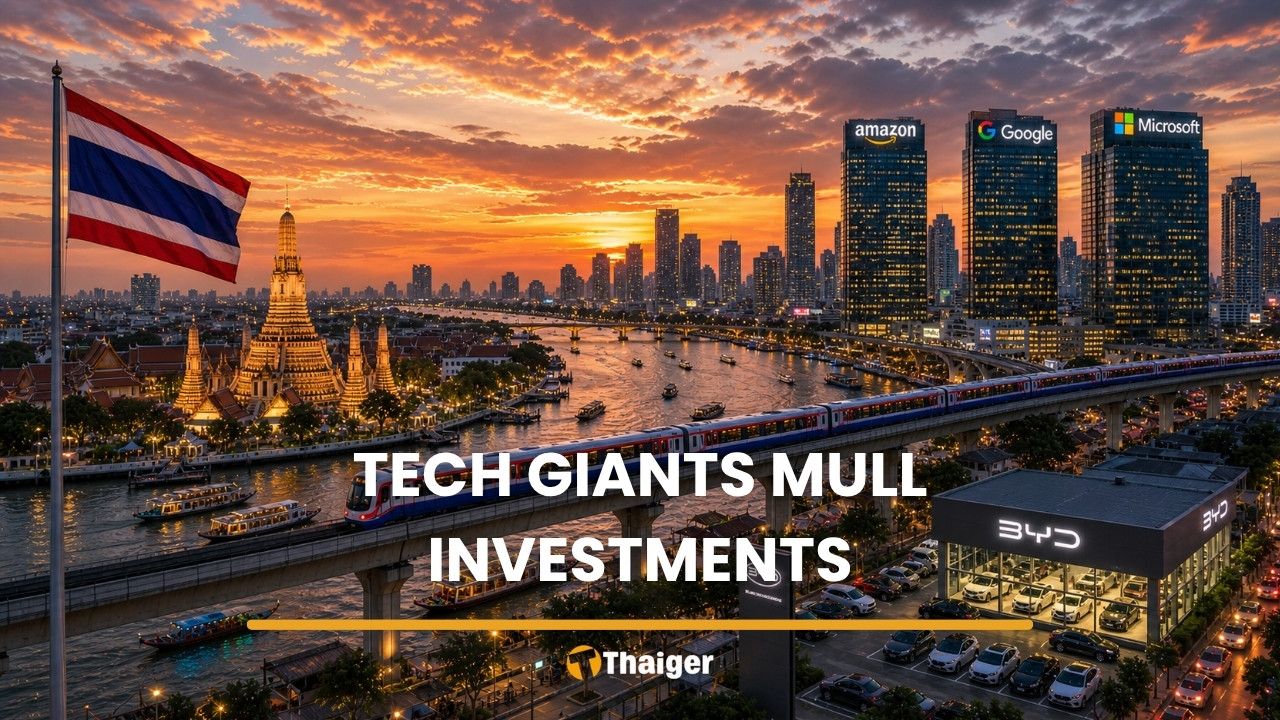
If you only looked at the investment scoreboard for Southeast Asian economies last year, chances are you would probably want to skip over Thailand. While Vietnam was sprinting ahead with 7% growth and Indonesia held steady at 5%, Thailand was limping with a meagre 2.4%.
With the IMF recently cutting its 2026 projection to a dismal 1.6%, the narrative that Thailand is a dying economy has inevitably become popular discourse among many analysts.
The numbers that keep economists awake
The pessimistic view is backed by some “ugly data” as Thailand’s household debt has ballooned to nearly 90% of its GDP, one of the highest ratios in Asia. This means that for many Thai families, most of their income is swallowed up by old loans long before they get a chance to spend it on daily life.
Then there is the issue of negative inflation. To a casual observer, falling prices might sound like a win for the consumer. In reality, it signals a deflationary trap where businesses cannot raise prices because customers simply have no money to spend.
It is a slow-motion squeeze on the middle class that mirrors the stagnation Japan faced for decades. Couple this with a population that is ageing faster than the economy is growing, and you have a recipe for a long-term decline.
The US$42 billion counter-argument
However, there is a gap between the headlines on social media and where the actual money is moving. In early 2026, Moody’s upgraded Thailand’s outlook from negative to stable. Their reasoning was backed by a sustained momentum in foreign investment.
Last year, Thailand’s Board of Investment recorded roughly US$42 billion in investment applications, marking the organisation’s 60-year high. These are not just speculative trades on a stock market by any means; these are massive, physical commitments in infrastructure that take years to plan and build.


Big tech enters the chat

The digital sector has officially overtaken electronics and automotive as the largest category for foreign investment in Thailand. The list of companies writing checks is among the who’s who of Silicon Valley:
- Amazon: Committed US$5 billion to launch a cloud region in Thailand.
- Google: Announced a US$1 billion investment to build data centres and cloud infrastructure.
- Microsoft: Following suit with significant investments in AI and cloud regions.
- ByteDance: Investing billions to ensure Thailand serves as a data hub for TikTok’s regional operations.
These investments in Thailand mark a move beyond short-term fluctuations in GDP as firms are positioning Thailand as their primary digital stronghold within Southeast Asia.
The new Detroit of Asia
Similarly, the automotive story is also undergoing quite a transformation. While Japanese marqess previously dominated the landscape, Chinese EV makers are increasingly posing a threat. BYD, Great Wall Motor, and Changan have collectively deployed billions of dollars into Thai manufacturing.
Thailand has effectively become the backdoor into the European market for these brands. By manufacturing in Thailand, automakers can ship cars to Germany and the UK under different tariff structures.
At the same time, Thailand is winning the high-end battle in electronics. As part of the China Plus One strategy, many of the world’s largest printed circuit board (PCB) manufacturers are shifting production to Thailand.
While Vietnam often gets the “low-cost assembly work”, Thailand is securing the capital-intensive, technically complex manufacturing for AI servers and high-margin electronics.
Two truths, one country
So, is Thailand finished, or is it just beginning its next chapter? The answer depends entirely on which version of the country you choose to see.
One version is struggling with debt, an ageing workforce, and stagnant domestic consumption. The other version is being built in parallel by global corporations who are betting that Thailand’s infrastructure and strategic location are worth more than the current macro headaches.
When there is a gap this large between the public narrative and cash flow, the money usually wins. Thailand might be moving slowly, but the foundation being laid right now suggests a much more complex and powerful future.
A tale of two markets in real estate

Adam Sutcliffe, Managing Director of Dot Property, highlights that this influx of industrial investment in Thailand is a double-edged sword for the local market.
“The massive land acquisitions for data centres and manufacturing plants are driving land prices through the roof in several key areas. Naturally, the cost of developing new projects is following suit.”
This price surge creates a significant barrier for the average citizen. Developers are forced to hike housing prices, making homeownership increasingly out of reach for middle-to-lower-income Thais in those zones.
The result is a “wealth concentration” effect where luxury projects are thriving on the back of foreign demand, while the mid-to-low segments are bogged down by high inventory because local buyers are being rejected for bank loans due to the crushing weight of household debt.
The tech magnet allure
However, the outlook is far from bleak for those looking at the upper end of the market. Sutcliffe views the arrival of tech giants like Google, Amazon, and Microsoft as a game-changer for rental demand.
“The decision to establish Cloud Regions in Thailand is attracting a new wave of global talent: software engineers, AI specialists, and high-level executives,
“These are individuals with significant purchasing power who demand high-quality housing in well-connected locations. We expect demand for premium rentals to skyrocket, which will push up yields in these hubs, even as the broader economy feels sluggish.”
Beyond corporate professionals, Thailand’s strengthening digital infrastructure is cementing its status as a top-tier destination for digital nomads. With some of the most stable and high-speed internet in the region paired with a competitive cost of living, the short-to-medium-term rental market is becoming a “gold mine” for investors who know where to look.
A strategic window for investors
For those with liquidity, the current credit crunch for locals is actually an opportunity. “While many struggle to get loans, this is a prime window for cash-rich or foreign investors,” Sutcliffe notes.
“Developers are aggressively pushing promotions and discounts to clear their existing stock, giving buyers unprecedented negotiating power. Buying into the market now, while prices are compressed but world-class infrastructure is arriving, is a very strategic long-term bet.”
The impact is most visible in the Eastern Economic Corridor (EEC), the heart of Thailand’s EV and high-end electronics manufacturing. The influx of engineers and families from China and Taiwan is creating massive demand for housing around industrial estates.
Unlike the broader market, these tech-driven jobs offer high income stability, making the property sector in these zones much more resilient to default risks. “I don’t believe Thailand is moving backwards; we are undergoing a structural reset,” Sutcliffe concludes.
“Traditional industries may be tired, but the new S-Curve industries are the new heroes that will revitalise the property sector, making it more modern and sustainable. Those who prepare for this transition today will be the ones reaping the biggest rewards when Thailand’s new economic engines hit full throttle.”
Latest Thailand News

























Follow The Thaiger on Google News: