Six quiet Thai provinces for a comfortable, slower way of life


Expats arriving in Thailand often gravitate toward Bangkok, Phuket, Chiang Mai, or, in some cases, Pattaya, as these have long been the default choice for those looking to relocate. But these quiet Thai provinces offer something the tourist hubs simply can’t: genuine slow living without sacrificing the infrastructure that makes long-term life manageable and worthwhile.
Across the country, university cities, regional medical hubs, and heritage towns deliver affordable housing, established healthcare networks, and authentic Thai daily life. You’d be mistaken to think of these simply as remote villages; they’re functional, connected cities that move at a more sustainable pace than Thailand’s major hubs.
Each city in this guide represents some of the most liveable, quiet Thai provinces with direct flights or rail access to Bangkok, at least one private hospital with English-language services, and an established expat community to ease the transition.
If you’re ready to trade the congestion and cost of Thailand’s major hubs for something more sustainable, here’s where expats are quietly, happily settling.
On this page
| Section | Summary |
|---|---|
| What makes a provincial Thai city work for long-term living | Cities suitable for expat life share key infrastructure such as transport links to Bangkok, private hospitals, reliable internet, and enough English-language services to support daily life. These locations offer slower living without sacrificing essential services. |
| Chiang Rai: Northern living with strong healthcare access | Affordable northern city with private hospital access, international flights to Bangkok, and a relaxed lifestyle. Seasonal haze from February to April is a health consideration. |
| Lampang: As quiet as it gets | One of the most affordable cities with strong local character and oncology services. Smaller expat community and fewer English-language services may require adjustment. |
| Khon Kaen: The Isaan medical hub | Regional healthcare centre with specialist hospitals and university support. Higher living costs but strong infrastructure for expats managing ongoing medical needs. |
| Udon Thani: The expat-friendly Isaan hub | Established expat community, strong hospital options, fast Bangkok flights, and good value cost of living. Can feel more Westernised than other provincial cities. |
| Ubon Ratchathani: Local life with city-scale infrastructure | Large provincial city offering authentic Thai living with public and private healthcare options. English-language services are more limited than in other cities. |
| Nakhon Ratchasima (Korat): The gateway city | Large regional hub with extensive healthcare and city-level services. No direct flights to Bangkok and higher utilities are key trade-offs. |
| Healthcare planning in provincial Thailand | Private hospital access exists in all cities but varies in specialist depth. Trauma coverage, smoke season, and emergency transfers are key healthcare planning considerations. |
| Cigna coverage for provincial living | Cigna Global plans offer direct billing, mental health support, telehealth, and emergency assistance. Coverage tiers range from Thailand-focused plans to unlimited global coverage. |
What makes a provincial Thai city work for long-term living
Slower living doesn’t mean remote or underserved. The cities that work best for long-term expats share a few practical qualities:
- Direct transport links to Bangkok for when you need specialist care or international flights
- Private hospitals that can handle emergencies without a referral merry-go-round
- Stable internet for remote workers
- Enough English-speaking services to handle daily life without constant frustration
The six cities profiled below perform well across these criteria, though each involves trade-offs. And these trade-offs may make or break your decision on where to settle.


Chiang Rai: Northern living with strong healthcare access

Thailand’s northernmost Lanna province is rich in culture with mountain landscapes and a city rhythm that feels markedly calmer than Chiang Mai.
Travel media and expat communities consistently describe Chiang Rai as a “slow down” destination, with its White Temple, Blue Temple, and proximity to the Golden Triangle rewarding longer stays.
The cost of living reflects that relative calm. A one-bedroom apartment in the city centre runs approximately 7,750 baht per month, with utilities for an 85m² apartment averaging around 1,608 baht monthly, according to Numbeo data. That’s noticeably lower than Chiang Mai across the board.
Also: A Stress-Free Guide to Renting in Thailand
Healthcare access is strong for a northern city of this size. The public anchor is Chiang Rai Prachanukroh Hospital, which operates as a major provincial centre with an English-language section. For private care, Bangkok Hospital Chiang Rai provides 24-hour trauma and emergency services with ambulance support, covering the full acute-care scenarios that matter most for insured retirees.
Direct flights connect Chiang Rai to Bangkok in approximately 1 hour and 15 minutes via Mae Fah Luang Chiang Rai International Airport.
Chiang Rai works best for:
- Expats wanting a northern Thailand lifestyle without Chiang Mai’s crowds and prices
- Retirees wanting private hospital access with 24/7 emergency capability
- Remote workers seeking a slower rhythm with reliable connectivity
- Nature enthusiasts and culturally engaged long-stay residents
One honest downside: Seasonal haze and smoke from February to April continues to be a genuine health concern. For retirees with respiratory or cardiac conditions, this should be factored into location decisions as seriously as any other healthcare variable.
Lampang: As quiet as it gets
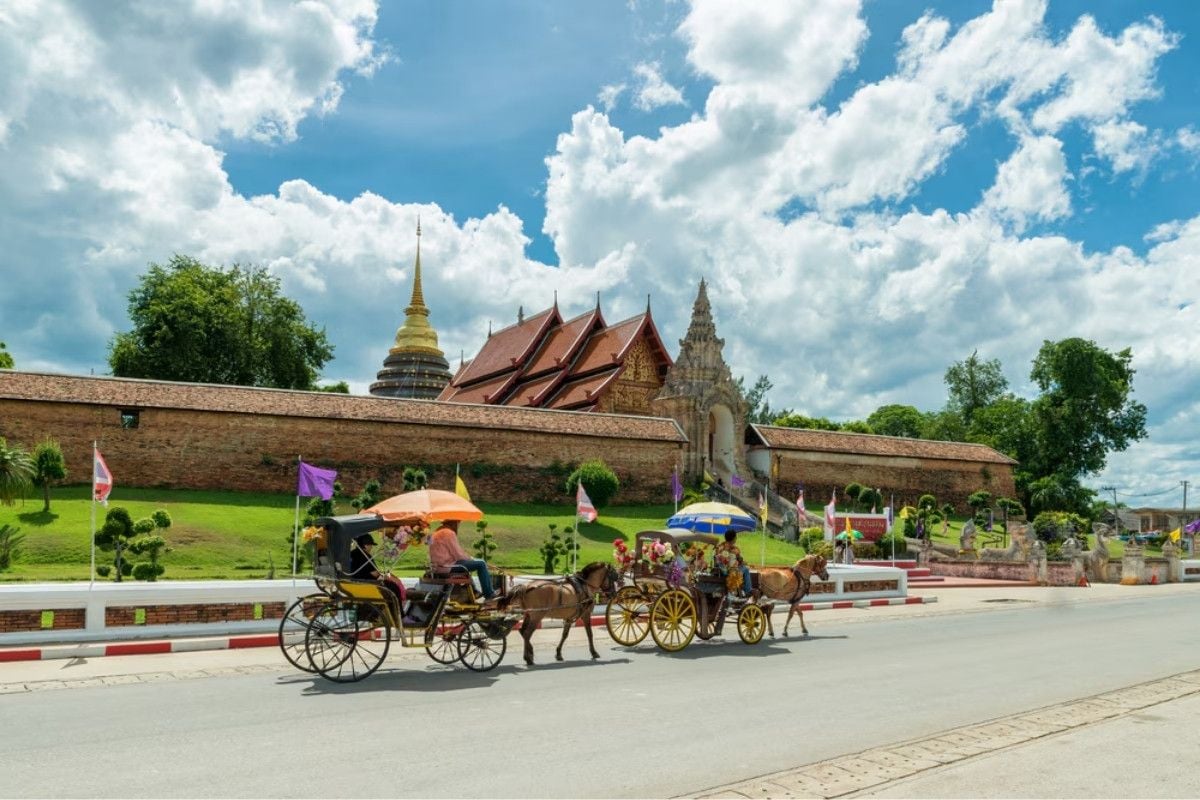
Lampang is a Lanna heritage city 100 kilometres south of Chiang Mai, where horse-drawn carriages still serve as taxis, one of the last cities in Thailand where this remains a functioning part of daily transport.
The city is often framed as an “understated retirement base”. Of all six cities here, Lampang arguably offers the most authentically Thai city experience with the least tourist overlay.
It’s also the most affordable. City-centre one-bedroom apartments average around 5,500 baht per month, with utilities running approximately 1,000 baht monthly, according to Numbeo. That’s the lowest rental cost of any city in this guide, and it translates to a materially different financial picture for retirees on fixed incomes.
Healthcare is solid for a city of its size. Lampang Hospital serves as the major public anchor, whilst Khelangnakorn-Ram Hospital operates as a private option with 24-hour services and emergency care. Notably, Lampang also hosts Lampang Cancer Hospital, providing specialist oncology pathways that are rare in a provincial city of roughly 704,000 people.
Air connectivity is more variable than in other cities on this list, but strong overland rail and road access to Chiang Mai and Bangkok provides practical backup for when specialist transfer is needed.
Lampang works best for:
- Budget-conscious retirees prioritising value over Western-oriented amenities
- Expats wanting genuine Thai city life with minimal tourist bubble
- Long-stay residents comfortable with a smaller international community
- Those within the practical range of Chiang Mai for supplemental services
The honest downside: A smaller international community means more language friction in daily life and healthcare administration. Lampang has fewer expat-oriented services than anywhere else on this list, which suits some people perfectly and frustrates others.
Khon Kaen: The Isaan medical hub
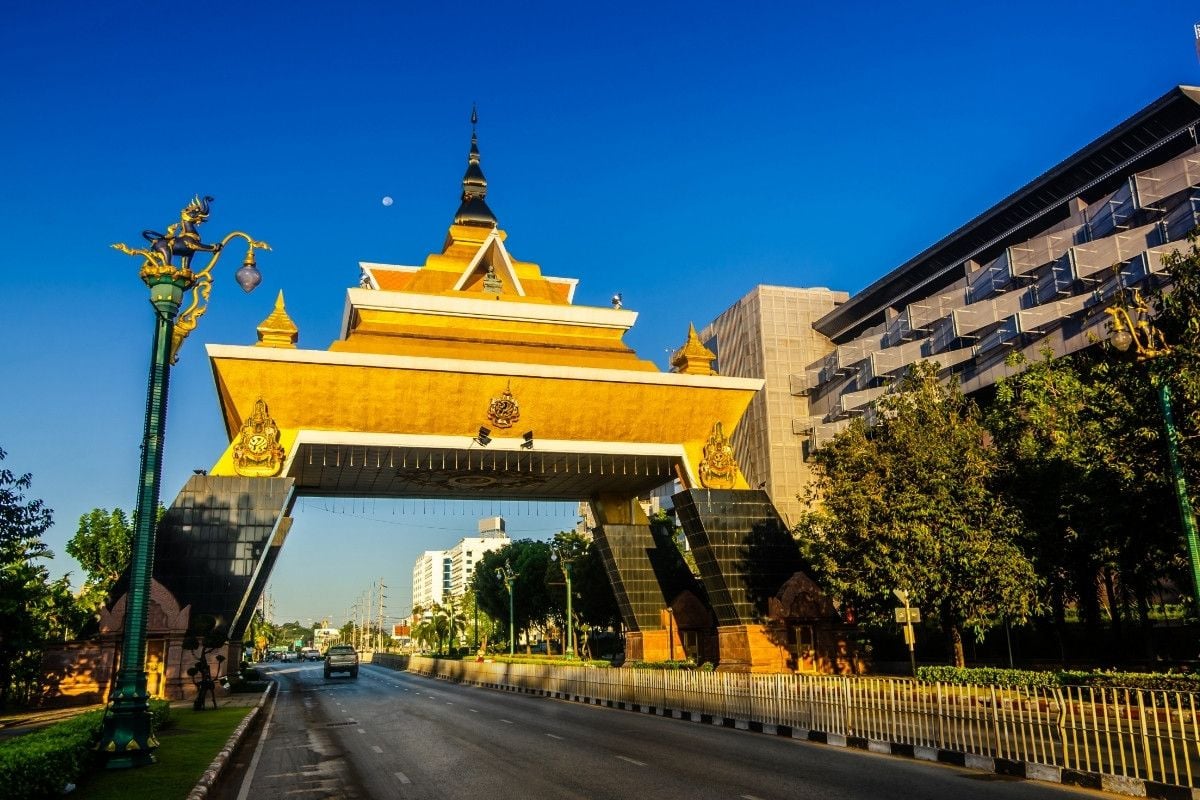
Among the six cities in this guide, Khon Kaen offers the greatest healthcare depth, a product of its status as a major university city and regional capital in the northeast.
Khon Kaen feels like a proper Thai city with genuine urban energy minus the intensity of Bangkok. The university presence keeps daily life lively and internationally minded, and the healthcare infrastructure it supports is genuinely impressive by provincial standards.
City-centre one-bedroom rents average 8,167 baht per month, with utilities for an 85m² apartment running around 2,194 baht monthly, according to Numbeo. That’s the highest rental cost on this list, but the service depth justifies the premium for expats who need regular specialist care.
The healthcare case for Khon Kaen is straightforward, with Srinagarind Hospital, operated by the Faculty of Medicine at Khon Kaen University, providing extensive clinical specialist services that few provincial cities can match. The private option, Khon Kaen Ram Hospital, is a 300-bed private facility covering broad specialities.
For expats managing chronic conditions or needing regular specialist follow-ups, Khon Kaen stands out among other quiet Thai provinces as one of the few places outside Bangkok where this combination is readily available.
Direct flights connect Khon Kaen to Bangkok in approximately one hour, and the city scores 7.5 out of 10 on expat friendliness measures in comparative research.
Also: The friendliest Thai cities for foreigners
Khon Kaen works best for:
- Retirees with chronic conditions needing regular specialist follow-ups
- Expats who want big-city infrastructure outside of Bangkok
- Those prioritising healthcare depth as their primary location factor
- Remote workers wanting university-city energy in a northeastern setting
The honest downside: Higher utility costs compared with other Isaan cities, and a less established international feel than Udon Thani for those prioritising community connections.
Udon Thani: The expat-friendly Isaan hub

Udon Thani scores highest of all six cities assessed in the underlying research, achieving an expat friendliness rating of 8.0 out of 10, thanks to a long-standing foreign community, a cross-border regional economy, and enough Western amenities to feel genuinely comfortable without becoming a resort bubble.
The cost picture is also quite attractive as city-centre one-bedroom apartments average around 6,000 baht per month, with utilities running approximately 2,058 baht monthly and broadband connectivity available for around 750 baht per month. For the level of services and community infrastructure on offer, that represents strong value.
Healthcare options are among the best of any city in this guide. Udon Thani Hospital provides the major public anchor, whilst Bangkok Hospital Udon operates as a private option with 24-hour emergency and trauma services, including Mobile ICU ambulances. Aek Udon International Hospital provides a third private option that adds genuine redundancy.
Flights to Bangkok take approximately 55 minutes from Udon Thani International Airport, making it the fastest Bangkok connection of any city profiled here.
Udon Thani works best for:
- First-time expats wanting the support of an established foreign community
- Retirees prioritising affordable living alongside private hospital access
- Remote workers who need reliable internet and strong Bangkok connectivity
- Those wanting multiple private hospital options for redundancy
The honest downside: Udon’s comfort and familiarity can create more of an expat bubble than a genuinely local Thai experience. Border proximity to Laos also means regional advisories should be monitored periodically, even if they rarely affect daily life.
Ubon Ratchathani: Local life with city-scale infrastructure

Ubon Ratchathani is a large northeastern provincial capital with a more Thai-domestic character than Udon Thani. It’s less internationally oriented but offers a diverse long-stay expat mix, particularly among those with family ties in Isaan or those seeking Thai daily life over Western-oriented convenience.
A standout natural attraction is Pha Taem National Park, a vast river valley on the Laos border that no other city on this list can rival. Mind you, it sits approximately 90 kilometres from the city centre, which makesit a perfect day trip.
City-centre one-bedroom apartments here average around 8,000 baht per month, with utilities for an 85m² apartment running approximately 2,000 baht monthly, according to Numbeo. Mid-range for this list, and reasonable given the city’s scale and service depth.
Healthcare coverage comes from Sunpasitthiprasong Hospital as the major public anchor and Ubonrak Thonburi Hospital as the private option, which positions itself as a modern facility with emergency services.
Direct flights to Bangkok take approximately one hour from Ubon Ratchathani Airport. The city scores 6.5 out of 10 on expat friendliness measures, reflecting a more locally oriented environment.
Ubon Ratchathani works best for:
- Expats with family or personal ties to the northeastern region
- Those wanting an authentic Thai city life alongside sizable city services
- Long-stay residents comfortable with public and private healthcare systems
- Nature-oriented expats drawn to the surrounding landscape
The honest downside: English-language services are thinner than in Udon Thani or Khon Kaen. Expats living near border districts should also monitor Cambodia-adjacent regional advisories, as border-area volatility can intermittently affect parts of the province.
Nakhon Ratchasima (Korat): The gateway city
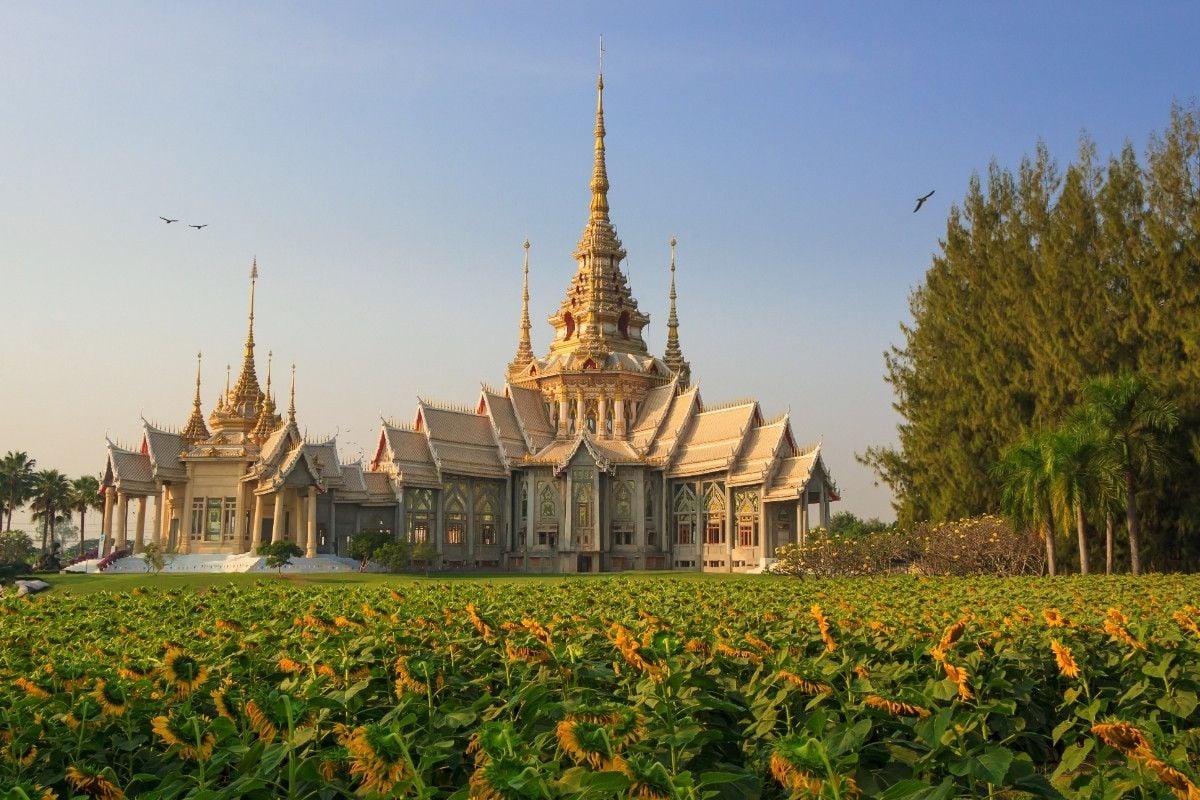
Nakhon Ratchasima, widely known as Korat, is Thailand’s largest province and the busiest city on this list. It functions as a regional gateway between central Thailand and the northeast, meaning metropolitan conveniences, deep healthcare infrastructure, and a more Thai-domestic feel than anything Bangkok can offer at a fraction of the price.
City-centre one-bedroom apartments average approximately 7,230 baht per month, though utilities run higher than in other cities at around 2,833 baht monthly for an 85m² apartment, according to Numbeo. Property purchase prices also trend higher than most provincial cities in this guide.
In terms of healthcare depth, Maharat Nakhon Ratchasima Hospital is a leading regional institution with large bed capacity, whilst Bangkok Hospital Ratchasima operates an international patient services department for expats wanting private care with English-language support.
Suranaree University of Technology Hospital adds further specialist depth that makes Korat comparable to Khon Kaen in terms of healthcare options.
However, if there’s one setback here, it’s the connectivity. Korat is primarily road and rail oriented, with no reliable direct flights to Bangkok currently. The journey by road or rail takes approximately 2.5 to 3 hours. Thailand’s high-speed rail segment between Bangkok and Nakhon Ratchasima is expected to begin broader operations around 2030, according to Reuters.
In terms of expat friendliness measures, the city scores 6.5 out of 10.
Nakhon Ratchasima works best for:
- Retirees wanting big-city healthcare infrastructure without Bangkok intensity
- Expats who are comfortable with road or rail travel rather than direct flights
- Those seeking the broadest service depth of any provincial city on this list
- Investors or long-stay residents drawn to metropolitan scale at provincial prices
The honest downside: No reliable direct flights to Bangkok are a genuine limitation for health emergencies or international travel. Korat also has one of the highest utility costs of any city in this guide. The busiest and least “slow” city profiled here can be a dealbreaker for some.
Healthcare planning in provincial Thailand
Living in a provincial Thai city means understanding exactly what healthcare you can access locally and when you’d need to transfer elsewhere. International health coverage with direct billing access makes things easier. Cigna Global’s plans for Thailand are designed specifically for this scenario.
All six cities have private hospital access, but the depth varies significantly. Khon Kaen and Udon Thani offer the strongest private hospital infrastructure, with tertiary specialist capability.
Lampang and Ubon Ratchathani function more as solid primary and emergency care providers, with complex cases referred to regional centres or Bangkok.
Bangkok Hospital network facilities in Chiang Rai, Udon Thani, Phitsanulok, and Korat provide direct billing access across key cities, meaning cashless treatment rather than upfront payment and claim submission.
Also: A Practical Way to Think About Healthcare When Living in Thailand
Road safety is the primary health risk for expats across all six cities and Thailand generally. Trauma coverage, ambulance access, and emergency routing planning matter more than crime statistics for practical safety planning.
Seasonal smoke and haze in northern cities, specifically Chiang Rai and Lampang, from February to April, represent a healthcare variable for retirees managing respiratory or cardiac conditions.
Cigna coverage for provincial living

Explore Cigna Global’s plans designed for long-stay expats in Thailand. Whether you’re settling in Khon Kaen for its medical infrastructure or Lampang for its heritage charm, the right coverage travels with you.
How Cigna’s plans break down:
- Close Care: US$500,000 per year for Thailand, plus your home country. Ideal for provincial expats whose travel remains primarily within Thailand and their home country. This meets visa compliance thresholds for O-A, O-X, and LTR visas, which require US$50,000 to US$100,000 minimum coverage depending on visa type.
- Silver: US$1,000,000 with diagnostics and hospitalisation. Balanced option for most long-stay expats.
- Gold: US$2,000,000 with routine maternity, cancer screenings, and specialist treatments. Best suited to cities with deeper specialist infrastructure, like Khon Kaen and Korat.
- Platinum: Unlimited coverage for those using premium providers like Bumrungrad or Bangkok Hospital network facilities.
All plans include direct billing at hundreds of Thai hospitals, mental health support with 24/7 hotlines and counselling access, wellness programmes for preventative care including physical exams and cancer screenings, global telehealth for video consultations with licensed GPs, and chronic condition management with dedicated clinical nurses.
The Medical Second Opinion service connects you with global specialists for complex diagnoses, which matters particularly when navigating a serious health decision in a provincial medical system. Crisis Assistance Plus™ covers non-medical emergencies, including natural disasters and regional instability.
Choosing your slower city

Each city on this list represents a different answer to the same question: how to live well in Thailand without Bangkok’s pace or Phuket’s prices.
Chiang Rai suits those drawn to northern Thailand for its culture, nature, and private hospital access. Lampang is for budget-conscious retirees wanting the quietest, most Thai experience available. Khon Kaen serves healthcare-first expats needing specialist depth in the northeast.
Udon Thani works for community-seekers and first-timers wanting established expat infrastructure. Ubon Ratchathani suits authentic Thai-life seekers with local connections to Isan. Nakhon Ratchasima delivers big-city healthcare infrastructure for expats comfortable without direct flights to Bangkok.
Slower living doesn’t mean remote living. These quiet Thai provinces prove you can swap Bangkok’s pace for something more sustainable without sacrificing the infrastructure that makes long-term expat life genuinely workable.
Get a quote from Cigna Global for provincial Thailand living. From Close Care℠ to Platinum, find the coverage that supports your life wherever in Thailand you choose to settle. Direct billing, emergency support, and mental health coverage are included as standard.
If shoreside living is more your tune, be sure to check out our other guide on the best beach towns in Thailand for long-term living.
*Cost of living figures sourced from Numbeo. Expat friendliness scores and flight times sourced from comparative research conducted in January 2026. All figures are approximations and subject to change.
Sponsored
Latest Thailand News
























Follow The Thaiger on Google News: