South
Officers demand 5 million baht bribe, hundreds riot – VIDEO

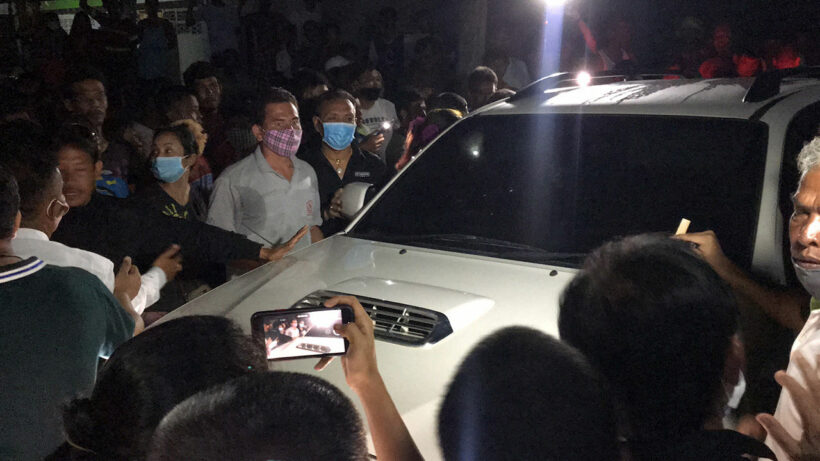
All claiming to be police officers, 3 men in Southern Thailand tried to extort a man for 5 million baht so he could avoid arrest. Somehow hundreds of villagers in Surat Thani got involved and surrounded the policeman’s Toyota Fortuner, according to Thai media. A video from Thai PBS shows villagers rocking the vehicle back and forth, and the rear window smashed.
Going back a bit, the ‘officers’ confronted the man when he was purchasing 500,000 baht worth of shellfish from local fishermen. The man explained that he was allowed to catch and sell the shellfish, but the officer, who Thai media report as part of the Surat Thani Police Division, still demanded 5 million baht. It’s unclear if the other 2 men were police officers.
When villagers heard about the outrageously high bribe, they formed a riot around the police vehicle. An officer from the Kanchanadit District Police Station got involved, but let the car drive off.
Score: Police 0 – Surat Thani community 1.
Recently, 6 policemen at the Klong Dan and Bang Phli police stations were accused of extortion and assault.
SOURCES: Thai Residents | Bangkok Post
Want more from the Thaiger family?
📱 Download our app on Android or iOS for instant updates on your mobile
📧 Subscribe to our daily email newsletter
👍 Like/Follow us on Facebook
🔔 Subscribe to or Join our YouTube channel for daily video updates
Insurgency
Thai ranger and 2 suspected insurgents killed in Thailand’s deep south
In the ongoing violence from the Southern Thailand insurgency, 2 suspected insurgents and a Thai ranger were killed in a clash between security forces and an armed rebel group in Yala’s Krong Pinang district. Known as Thailand’s “deep south,” the provinces Yala, Narathiwat, and Pattani, along the Malaysia border, have been plagued with violence for years due to the religious separatist insurgency.
Law enforcement officers had received a tip that suspected insurgents, who were wanted on court warrants, were staying in the Batu Buela and Bae Chaeng villages. A team of police and soldiers, along with some civilians, were deployed to the villages. 30 year old Wan Asan Asu, who had a warrant out for his arrest, surrendered to officers while other suspected insurgents responded with gunfire.
Shots were fired from both sides for about 2 hours. Nopparit Sukson, a ranger of the Yala-based 47th Ranger Regiment, was killed in the clash. Officers searched the area after the gunfire exchange and found the bodies of 2 men who had warrants out for their arrest. Each had an AK47 rifle and one of them also had a pistol.
More officers have been called to help clear the area today.
SOURCE: Bangkok Post
Want more from the Thaiger family?
📱 Download our app on Android or iOS for instant updates on your mobile
📧 Subscribe to our daily email newsletter
👍 Like/Follow us on Facebook
🔔 Subscribe to or Join our YouTube channel for daily video updates
Insurgency
Thailand’s Southern Insurgency – who’s fighting who?
Trouble in the ‘south’. Attacks against civilians and rangers. Insurgents attack Thai soldiers – the sorts of headlines that people have read about Thailand’s southern conflict for the past 70 years or so.
Thaiger readers may wonder who’s fighting who, and why. The area has been coined the ‘deep south’ or the ‘restive south’ and has become, statistically, a more bloody conflict than the situation on the Gaza Peninsula in the middle east – it just gets a lot less international coverage.
Where is the ‘south’? The three Thai provinces of Pattani, Yala and Narathiwat, and sometimes Songkhla, are the locations where most of the violence takes place, all near or bordering Malaysia. The border, usually fluid with tourists and local trade, are now closed due to the current Covid situation.

Despite successive Thai and Malaysian governments throwing words and resources at the problem, very little has been done to reduce the spate of violence, usually affecting southern civilians as well.
The South Thailand insurgency (Thai: ความไม่สงบในชายแดนภาคใต้ของประเทศไทย; Malay: Pemberontakan di Selatan Thailand) is an ongoing conflict centered around southern Thailand’s disputed border region with Malaysia. Although there’s been bubbling discontent around the region since the start of the 20th century, it emerged as a serious issue for the Malaysian and Thai governments in 1948 as an ethnic and religious separatist insurgency in the historical Malay Patani region.
It has become a more complex ‘land grab’, and increasingly violent since the early 2000s due to drug cartels, oil smuggling networks, and occasionally even pirates.
The former Sultanate of Patani, which included the southern Thai provinces of Pattani, Yala and Narathiwat, also known as the three Southern Border Provinces (SBP), as well as parts of neighbouring Songkhla province and the northeastern part of Malaysia (Kelantan), was conquered and, except for Kelantan, has been governed by, Thailand (formerly The Kingdom Siam) since 1785.
Although low-level separatist violence had occurred in the region for decades, the campaign escalated after 2001, with a major recurrence in 2004, and has occasionally spilled over into other provinces. Incidents blamed on southern insurgents, including bombings, have reached as far as the capital Bangkok and the holiday island Phuket.
In 2005, PM Thaksin Shinawatra assumed wide ranging emergency powers to deal with the southern violence, but his actions served only to escalate the insurgency. In September 2006, Thaksin was ousted in one of Thailand’s periodic military coups.
The subsequent junta implemented a major policy shift, replacing Thaksin’s earlier approach with a campaign to win over the “hearts and minds” of the insurgents. That didn’t have much effect either.
Despite little progress in curbing the violence, the junta declared that security was improving and that peace would come to the region by 2008. By March of that year, however, the death toll had surpassed 3,000.
During the Democrat-led government of Abhisit Vejjajiva, Foreign Minister Kasit Piromya noted a “sense of optimism,” but by the end of 2010 insurgency-related violence had increased, confounding the government’s optimism. Finally in March 2011, the government conceded that violence was increasing and could not be solved in a few months.
Local leaders have persistently demanded at least a level of autonomy from Thailand for the Patani region and some of the separatist insurgent movements have made a series of demands for peace talks and negotiations. However, these groups have been largely sidelined by the Barisan Revolusi Nasional-Koordinasi (BRN-C), the Muslim fundamentalist group currently spearheading the insurgency. The BRN-C has as its announced aim to make southern Thailand ungovernable and it has largely been successful.
Estimates of the strength of the insurgency vary greatly. In 2004 General Pallop Pinmanee claimed that there were only 500 hardcore ‘jihadists’. Other estimates say there as many as 15,000 armed insurgents. Around 2004 some Thai analysts believed that foreign Islamic terrorist groups were infiltrating the area, and that foreign funds and arms were being brought in, though again, such claims were balanced by an equally large body of opinion suggesting this remains a distinctly local conflict.
Is it safe to travel through Thailand’s south? Mostly, yes. There is a lot of security and patrols around the area these days and the attacks are relatively rare. The Thai government have much better intel about possible attacks than in the past and react quickly to any potential security problems.
Over 6,500 people died and almost 12,000 were injured between 2004 and 2015 in a formerly ethnic separatist insurgency, which has currently been taken over by hard-line jihadis and pitted them against both the Thai-speaking Buddhist minority and local Muslims who have a moderate approach or who support the Thai government.
You can read another aspect of the southern conflict from The Thaiger…
Boom boom on the border – Thailand’s unlikely red-light district
For a timeline of major events in the Southern Insurgency, click HERE.
Want more from the Thaiger family?
📱 Download our app on Android or iOS for instant updates on your mobile
📧 Subscribe to our daily email newsletter
👍 Like/Follow us on Facebook
🔔 Subscribe to or Join our YouTube channel for daily video updates
Coronavirus (Covid-19)
Locals threaten to burn hall if converted to field hospital
Citing fears of Covid-19 spreading, terrified locals threatened to burn down a Nakhon Si Thammarat conference hall authorities were preparing as a possible field hospital. The hall in the Muang district was one of several locations provincial authorities were readying as potential makeshift medical care facilities if the Covid-19 outbreak worsens. As of now, the governor chose 3 sites at Phra Phrom Hospital, Walailak University and Phor Than Khlai Hospital to be used for field hospitals, so far avoiding this panicked backlash.
Residents hung banners in front of Thung Thalad conference hall with messages of opposition, with one sign saying directly that if the municipality sets up a field hospital, the residents of Na Khian will burn it down. Local leaders explain that the townspeople are terrified that patients will be brought from other areas with their Covid-19 infections and the medical facility would bring an outbreak of Coronavirus in their neighbourhood.
The local residents did offer a concession, however, as an alternative to the hall they threatened to burn if converted to a field hospital. Townspeople said they would allow Ban Khlong Din School to use one building as a quarantine facility only for local people who are at risk of infection. The 3 field hospitals that the provincial communicable disease control panel had already agreed to set up would only be used to treat patients from established hospitals who were experiencing only mild symptoms.
In Nakhon Si Thammarat now, tourist-friendly walking streets and markets are temporarily closed and fresh markets and flea markets would also be closed for 2 days to undergo a thorough cleaning and disinfection. Service establishments and other Covid-19 prone businesses had been closed for 14 days, but that order was extended indefinitely until the outbreak calms. Festivals and other large group gatherings have been cancelled and banned as well. The only exception is for funerals, where Covid-19 safety protocols must be strictly enforced and attendees limited to 50 people.
SOURCE: Phuket News
Want more from the Thaiger family?
📱 Download our app on Android or iOS for instant updates on your mobile
📧 Subscribe to our daily email newsletter
👍 Like/Follow us on Facebook
🔔 Subscribe to or Join our YouTube channel for daily video updates
-
Coronavirus (Covid-19)3 days ago6 of Thailand’s top tourist zones WILL start opening for quarantine-free travel in July – TAT
-
Technology4 days agoGlobal chip shortage: automakers to sex toys now feeling the pinch
-
Bangkok1 day agoThursday Covid UPDATE: 18 deaths and 1,911 new infections
-
Hot News2 days agoOwner of 2 unsupervised pit bulls warned by mayor
-
Media4 days ago“Let’s Move Abroad” Thai Facebook group exploding with potential defectors
-
Coronavirus (Covid-19)2 days agoVaccines reserved for Thais, not expats – Public Health Ministry
-
Economy2 days ago225 billion baht Covid-19 stimulus package gets initial approval
-
Coronavirus (Covid-19)2 days agoRising Phuket Covid-19 infections may cause ICU shortage


Glenn
Friday, May 22, 2020 at 8:41 am
555, as it should be!