Bangkok hits a ‘Dangerous’ heat index: BMA issues urgent health alert

Bangkok hits a dangerous heat index. Stay safe as extreme heat and storms are forecast across Thailand. Learn how to protect your health and crops this week.
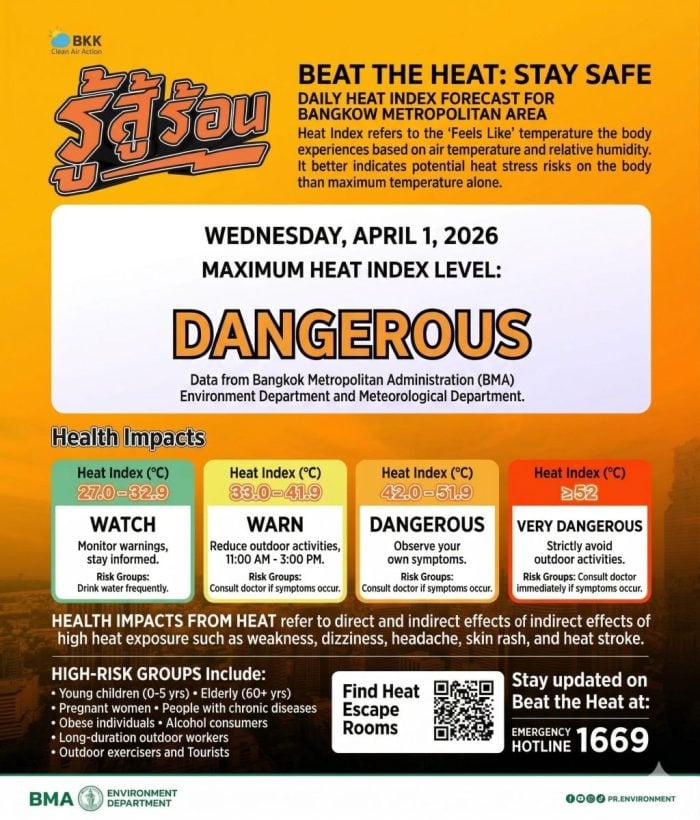
The Bangkok Metropolitan Administration (BMA) issued a formal alert on Wednesday, April 1, 2026, stating that the heat index (a measure of how hot it feels when humidity is factored in with the actual air temperature) has climbed into the “Dangerous” category.
Health officials have advised the general public to closely monitor their physical condition, while vulnerable groups are urged to seek immediate medical attention if they experience any abnormal symptoms related to heat exhaustion.
The Thai Meteorological Department (TMD) reported that a low-pressure cell caused by intense heat is currently covering upper Thailand. This system is bringing widespread hot weather and haze during the day, with extreme heat expected in parts of the North, Northeast, and Central regions.
Despite the intense heat, weak southerly and southwesterly winds are still prevailing, which may trigger isolated thunderstorms and gusty winds in some areas. Residents are advised to avoid prolonged outdoor activities and remain cautious of potential dangers from sudden storms, including falling trees and unsecured billboards.
Southern Thailand is also experiencing hot daytime conditions with scattered thunderstorms as easterly and southeasterly winds move across the Gulf of Thailand and the Andaman Sea. Sea conditions remain relatively calm, with waves averaging 1 meter, though heights may exceed 1 meter during thunderstorms.


The TMD’s seven-day outlook (April 1–7) suggests that the extreme heat will persist across most of upper Thailand. Farmers in these regions have been advised to reinforce agricultural structures and prepare for potential damage to crops and livestock caused by erratic weather patterns.
Meanwhile, air quality remains a concern in the North and Northeast. Haze and particulate matter (PM2.5) continue to accumulate at relatively high levels due to a high density of hotspots and poor air ventilation in those regions.
In a separate report, a 2.1-magnitude earthquake was detected in Myanmar between March 31 and April 1. Authorities confirmed the event had no impact on Thailand.
Latest Thailand News

























Follow The Thaiger on Google News: