Bank of Thailand cuts GDP forecast to 1.5%, slashes interest rate to 1% as war and trade pressures bite

Thailand’s central bank has issued its starkest economic warning in years. The Bank of Thailand’s (BOT) Monetary Policy Report for Q1 2026 revised the country’s GDP growth forecast sharply downward to just 1.5%, well below the 2.4% recorded in 2025, as the Monetary Policy Committee (MPC) voted to cut the benchmark interest rate to a historic low of 1.00% per year to cushion a slowing economy.
Why growth is slowing
Two forces are hitting Thailand at once, and neither is easy to resolve quickly.
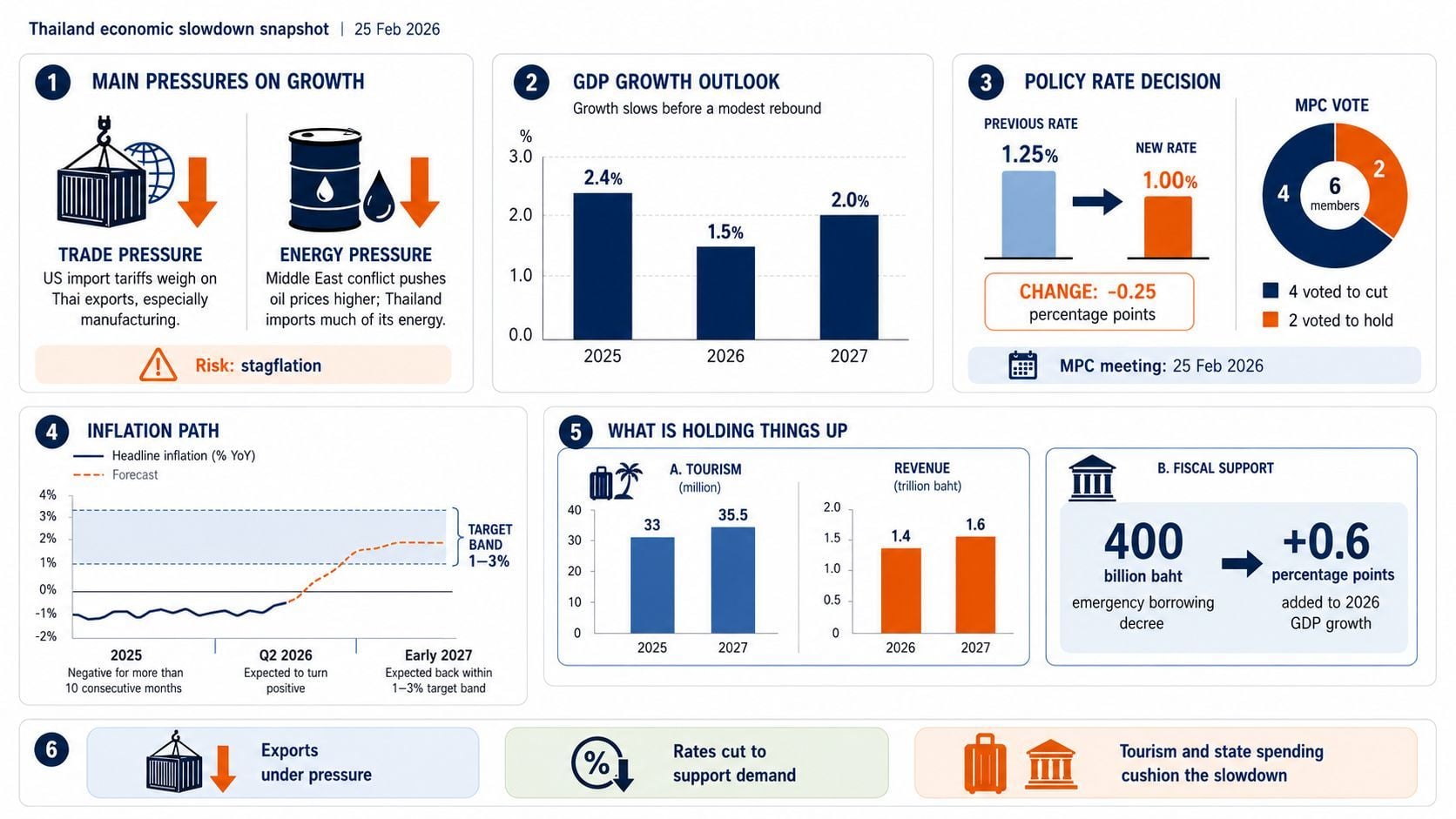
The BOT said Thailand’s economy is likely to expand more slowly than previously expected, dragged down by prolonged geopolitical pressures and structural shifts in global production. GDP growth is now projected at 1.5% for 2026, before recovering to around 2.0% in 2027.
The first pressure is trade. US import tariffs continue to weigh on Thai exports, particularly in manufacturing. The second is energy. The ongoing Middle East conflict has pushed global oil prices higher, a heavy burden for Thailand, which imports a large share of its energy needs. Analysts at SCB EIC have warned that this combination could push Thailand toward stagflation, a situation in which growth slows while inflation rises, affecting the economy through five key transmission channels.

A rate cut, but not a unanimous one
At its meeting on 25 February 2026, the MPC voted 4 to 2 to cut the policy interest rate by 0.25 percentage points, from 1.25% to 1.00% per year, effective immediately. The two dissenting members preferred to hold the rate steady at 1.25%.
The split vote matters. It signals genuine disagreement within the committee about the right path forward. The majority of cutting camp argued that lower rates are needed to ease the debt burden on small businesses and households, and to stimulate domestic demand that has remained weak. The minority-holding camp worried that policy space is narrowing and that inflation risks from energy prices could resurface, making further cuts harder to justify later.
Inflation is low, but not dangerously so
Headline inflation has been in negative territory for more than ten consecutive months. Despite that, the BOT is not sounding a deflation alarm. The central bank expects headline inflation to turn positive in Q2 2026 and return within the 1 to 3% target band by early 2027.


The BOT assesses that low inflation is being driven primarily by cheaper energy and fresh food prices, not by a broad collapse in demand. Most goods and services are still either holding steady or inching upward in price, and private sector medium-term inflation expectations remain anchored within the target range.
Tourism holds up, government spending steps in
With exports under pressure and domestic consumption soft, two stabilising forces are keeping the economy from deteriorating further.
The BOT projects 33 million international tourist arrivals in 2026, generating around 1.4 trillion baht in tourism revenue, rising to 35.5 million arrivals and 1.6 trillion baht in 2027.
On the fiscal side, the government’s 400-billion-baht emergency borrowing decree is expected to add around 0.6 percentage points to GDP growth in 2026. With the new government forming faster than anticipated, the 2027 national budget is on track to be approved on schedule, which should support spending in Q4 of this year.
What this means for ordinary Thais
For households and small businesses, the rate cut is a direct signal that borrowing costs are coming down. Banks are expected to gradually pass the cut through to loan rates, easing repayments for those carrying mortgages, car loans, or business debt.
For savers, the flip side is lower deposit returns. Anyone keeping money in fixed deposits will earn less than before.
For the broader economy, the outlook hinges on three things the BOT says it is watching closely: whether global energy prices stabilise, how US tariff negotiations play out, and whether government spending reaches the real economy fast enough to offset the drag from weaker exports.
The central bank has signalled it retains room to cut again if conditions worsen, but warned it will move carefully, given that interest rates are already at historically low levels and further cuts carry diminishing returns.
Sources: Bank of Thailand Monetary Policy Report Q1/2026 and Monetary Policy Forum 1/2026
Latest Thailand News

























Follow The Thaiger on Google News: