Thailand’s corruption score falls in 2025 index

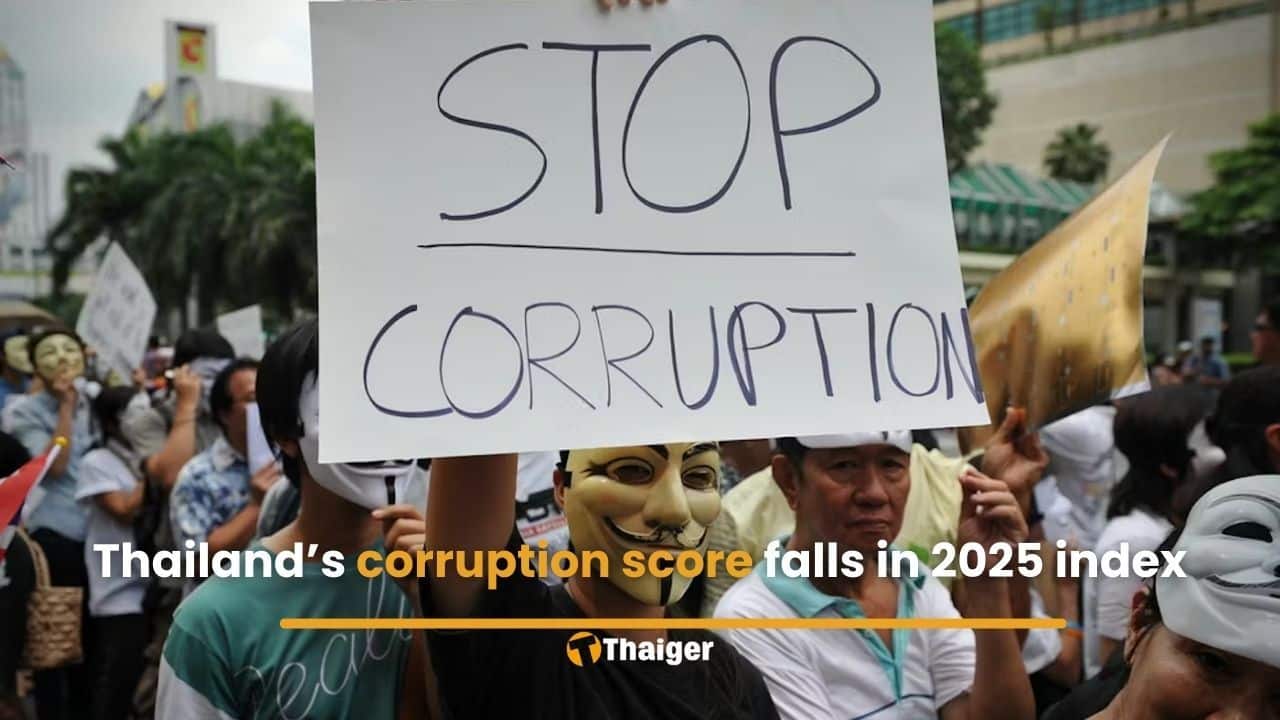
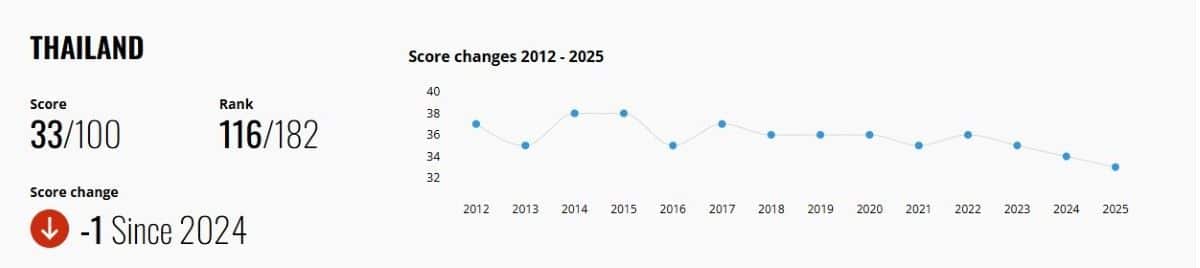
Thailand’s score in the 2025 Corruption Perceptions Index (CPI) slid to 33 out of 100, down from 34 the year before, placing the country 116th out of 182 countries in the global rankings, according to Transparency International’s latest survey released yesterday, February 10.
The CPI, published annually by the global anti‑corruption watchdog, ranks nations by perceived levels of public‑sector corruption based on expert and business evaluations. The scale runs from 0 (highly corrupt) to 100 (very clean).
Denmark topped the 2025 list with a score of 89 points, followed by Finland (88), Singapore (84), New Zealand and Norway (81 each). At the other end of the spectrum, South Sudan and Somalia scored 9, with Venezuela at 10, reflecting widespread concerns about governance in those countries.
Thailand’s result matches or trails several other nations, with countries like Ecuador, Panama and Serbia also scoring 33 points. Within the Association of Southeast Asian Nations (ASEAN), Thailand placed behind Singapore, Brunei, Malaysia, Timor‑Leste, Vietnam and Indonesia, and ahead of only a few peers. Myanmar remained the lowest in the region.
The 2025 score marks one of the lowest levels for Thailand in nearly two decades, reflecting ongoing challenges in curbing corruption perceptions despite repeated government pledges, as reported by Bangkok Post. Over the past decade, Thailand’s highest CPI score was 38 (achieved in 2014 and 2015), while rankings have fluctuated as global benchmarks change.
The global average CPI score in 2025 fell to 42, with 122 countries scoring below 50, a threshold widely seen as indicating significant public‑sector corruption. Transparency International noted that corruption risks are rising even in traditionally strong democracies, and that only five countries now score above 80, down from 12 a decade ago.
In its analysis, the Berlin‑based organisation also highlighted a correlation between shrinking civic space and weakening control of corruption, warning that leaders who concentrate power and sideline checks and balances risk further erosion of transparency and accountability.


The CPI is widely used as a benchmark for investment climate assessments and governance evaluations, though it measures perceived corruption rather than documented cases. Its methodology encompasses 13 independent data sources and is intended to capture expert and business perceptions of public‑sector integrity.
As Thailand’s ranking slips, public debate around governance, anticorruption policies, and the effectiveness of reforms is expected to intensify, particularly in the lead‑up to the next major election cycle.
Latest Thailand News























Follow The Thaiger on Google News: