Modern loft-style villas launched in Chalong

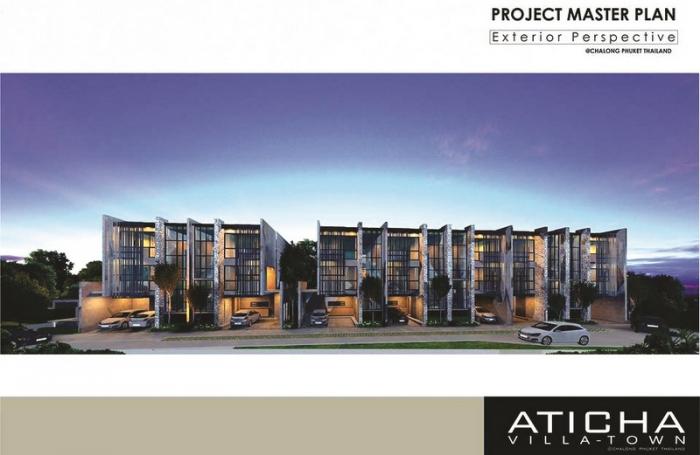
PHUKET: A new residential project was launched in Chalong last month, revealed Wanthwa Phuengchai, marketing manager of the Phuket Exclusive Development Company Limited.

The project will be called Aticha Villa Town, and will be suitable for residents who want to live in Phuket in a modern, loft-style villa, close to the amenities of urban living, but within the atmosphere of a holiday home or villa. Each property will feature a private pool.

The company says that the target market for the new project is expats living in Phuket. The villas are located near Chalong Circle, which is a “high security” area.

ADVERTISEMENT

Ms Wanthiwa stated that a total of seven villas are being constructed, each three storeys high, with an additional ‘roof floor’ that is part of the new concept.

The smallest property (128 square meters) will cost about 9.8 million baht, whereas the largest one (192 sqm) will be priced at about 11.6mn baht. The latter will consist of three bedrooms, four bathrooms, a living room, an office space, a kitchen and a private parking area.

These properties are designed around the ‘minimalistic’ design concept, which is “rare nowadays”, the company revealed. Construction is in progress and is expected to be completed by December.

— Sukawin Tanthavanich

ADVERTISEMENT

Thailand Property FAQ

Can foreigners buy property in Thailand?

Yes. Foreigners can own condominium units freehold, as long as foreign buyers hold no more than 49% of the building's saleable area. Land cannot be owned directly by foreigners; houses are usually held through a 30-year lease — and since a March 2025 Supreme Court ruling, automatic “30+30+30” renewal structures are not enforceable beyond the first 30 years. Read the full foreign-ownership guide.

What is Thailand's 49% foreign quota?

In any condominium project, no more than 49% of the total saleable floor area can be foreign-owned. The quota applies only to condos — not houses, land or leaseholds — and popular buildings in Bangkok, Phuket and Pattaya can hit the cap. How the quota works in practice.

How much are property transfer fees in 2026?

The transfer registration fee is cut to 0.01% (from the standard 2%) and the mortgage registration fee to 0.01% (from 1%) for purchases where both the price and assessed value are 7 million baht or less — extended by the Cabinet on June 30, 2026. On a 6-million-baht home that saves around 120,000 baht. Who qualifies for the cut · Standard fees & who pays what.

Is it better to rent or buy in Thailand as an expat?

It mostly depends on your time horizon: for stays under roughly five years renting usually wins once transfer costs and resale friction are counted, while longer stays can favour buying — especially with 2026's reduced fees. The rent-vs-buy maths for expats.

How much does property cost in Thailand?

A little over 2 million baht buys a freehold one-bedroom condo in central Chiang Mai — the same budget covers only a studio in Bangkok's CBD. Prices vary sharply by region and city. Average prices by region, and what they buy you.

What taxes do property owners pay in Thailand?

Owners pay the annual land and building tax, and rental income is taxable; buyers and sellers split one-off costs like transfer fees, stamp duty or specific business tax depending on the deal. The go-to guide to Thai property taxes.

Legacy Phuket Gazette

Archiving articles from the Phuket Gazette circa 1998 - 2017. View the Phuket Gazette online archive and Digital Gazette PDF Prints.
Back to top button