Sansiri launches Child-Friendly Space in Phuket [Video]

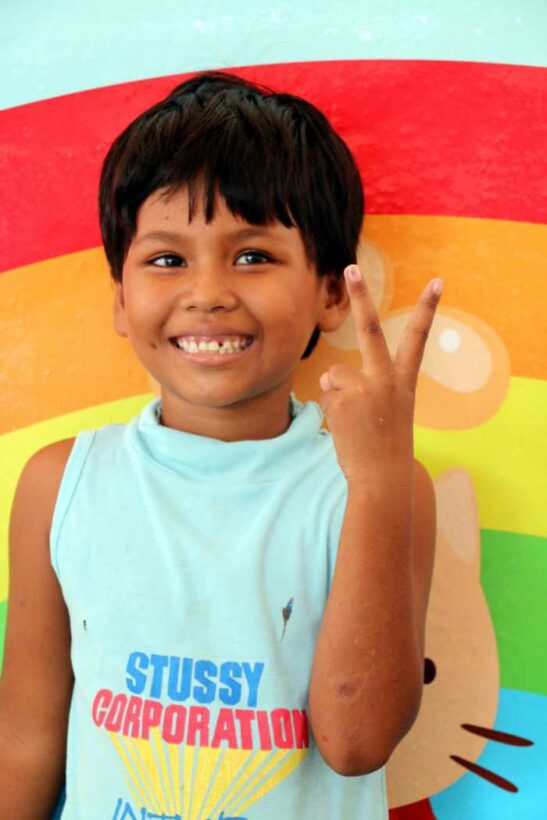
PHUKET: Living up to the standards set by it’s own Corporate Social Responsibility (CSR) program “Sansiri Social Change”, which aims to help support and improve children’s lives, Sansiri launched its new Child-Friendly Space in Mai Khao to provide education in a safe environment for the children of construction workers.
The project, located near the construction site of Baan Mai Khao development, was officially launched on July 21 during a ceremony honored by Phuket Governor Maitree Inthusut. An open-air classroom is available to all children of construction workers inhabiting the nearby camp who can leave their children in safety and under supervision while they are at work.
“Kids arrive here everyday at 9am and can stay until 2pm. They participate in a number of activities, they learn Thai and English and play. There is a volunteer teacher and caretakers present at all times,” explained Paniti Chantayasakorn, Senior Corporate brand communications manager at Sansiri.
There are currently 10 volunteers responsible for the children’s safety. Some are Sansiri staff volunteering their time under the company’s internal campaign to promote social responsibility.
The Phuket Child-Friendly Space was initiated by Sansiri together with Unicef and Alliance Corp and is yet another such project in Thailand with Child-Friendly Spaces already active in Chiang Mai, Hat Yai, Hua Hin, Koh Tao and in many other locations around the country.
Child-Friendly Space is another project in line with Sansiri’s Social Change activities. Other examples of the company’s CSR activities include the “give” campaign with the objective of amplifying the voices of Phuket’s youth’s thinking, presentation and documentary-making skills, allowing them to create real projects to help improve the Phuket community and the Sansiri Academy launched in Phuket in 2012 which provides free football training to encourage children to use their free time wisely and help them develop their talents and potential. Two children from the Academy have since joined the Thai national youth football team.
The Child-Friendly Space in Phuket currently caters to approximately 30 children while there are 70 kids living in the nearby workers camp.


“As of now only around half of the children from the camp attend our school,” explained Chantayasakorn.
“The rest are not yet being allowed to attend by their parents. We are working with UNICEF to understand why parents don’t want their children in school,” she added.
— Maciek Klimowicz


Thailand Property FAQ
Can foreigners buy property in Thailand?
Yes. Foreigners can own condominium units freehold, as long as foreign buyers hold no more than 49% of the building's saleable area. Land cannot be owned directly by foreigners; houses are usually held through a 30-year lease — and since a March 2025 Supreme Court ruling, automatic “30+30+30” renewal structures are not enforceable beyond the first 30 years. Read the full foreign-ownership guide.
What is Thailand's 49% foreign quota?
In any condominium project, no more than 49% of the total saleable floor area can be foreign-owned. The quota applies only to condos — not houses, land or leaseholds — and popular buildings in Bangkok, Phuket and Pattaya can hit the cap. How the quota works in practice.
How much are property transfer fees in 2026?
The transfer registration fee is cut to 0.01% (from the standard 2%) and the mortgage registration fee to 0.01% (from 1%) for purchases where both the price and assessed value are 7 million baht or less — extended by the Cabinet on June 30, 2026. On a 6-million-baht home that saves around 120,000 baht. Who qualifies for the cut · Standard fees & who pays what.
Is it better to rent or buy in Thailand as an expat?
It mostly depends on your time horizon: for stays under roughly five years renting usually wins once transfer costs and resale friction are counted, while longer stays can favour buying — especially with 2026's reduced fees. The rent-vs-buy maths for expats.
How much does property cost in Thailand?
A little over 2 million baht buys a freehold one-bedroom condo in central Chiang Mai — the same budget covers only a studio in Bangkok's CBD. Prices vary sharply by region and city. Average prices by region, and what they buy you.
What taxes do property owners pay in Thailand?
Owners pay the annual land and building tax, and rental income is taxable; buyers and sellers split one-off costs like transfer fees, stamp duty or specific business tax depending on the deal. The go-to guide to Thai property taxes.